It is now February 10, 2026, morning.
Yesterday, I made some improvements to SandTable, which can now support reading CSV data. The previous version could only generate GBM synthetic data. So I quickly imported recent BTC data (20,000 candlesticks) for testing. The results show that the baseline signal performs poorly on BTC 5m data, even worse than random signals. On 15m, 30m, and 1h data, the top performer is the trend-following dual moving average strategy.
In terms of the improvement effect of the anti-Martingale betting strategy, the results are very good.
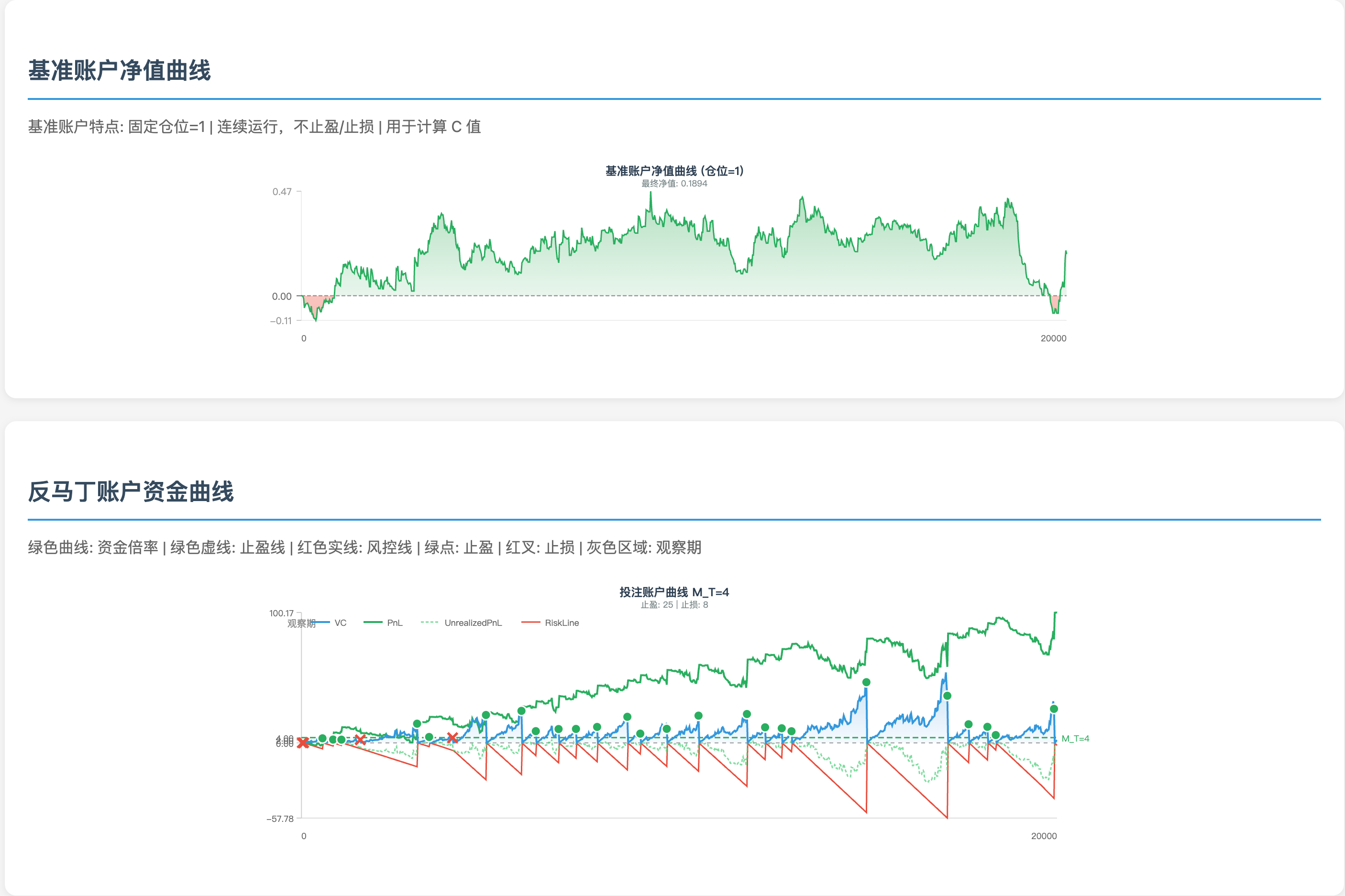
This is a comparison of the equity curves for the most recent 20,000 candlesticks of BTC 1h. It can be seen that the baseline signal has experienced significant drawdowns recently, while the equity curve of the anti-Martingale betting strategy is relatively stable, with only periodic drawdowns. It increases position size during favorable conditions and reduces position size while staying in the market during unfavorable conditions, creating new highs in a stepwise manner.
The final return of the baseline strategy is 18.94%, while the return of the anti-Martingale betting strategy is 9994.17%, a difference that is incomparable. From the equity curve, it is also evident that the anti-Martingale strategy exhibits better stability.
What insights can this bring us?
- Favorable condition clustering indeed exists.
- The anti-Martingale betting strategy can effectively leverage the characteristics of favorable condition clustering to improve overall returns.
Let’s look at another extreme example. If the anti-Martingale strategy uses a 1024x TP parameter (taking profit only at 1024 times the profit), the signal strategy will exhibit completely different characteristics.
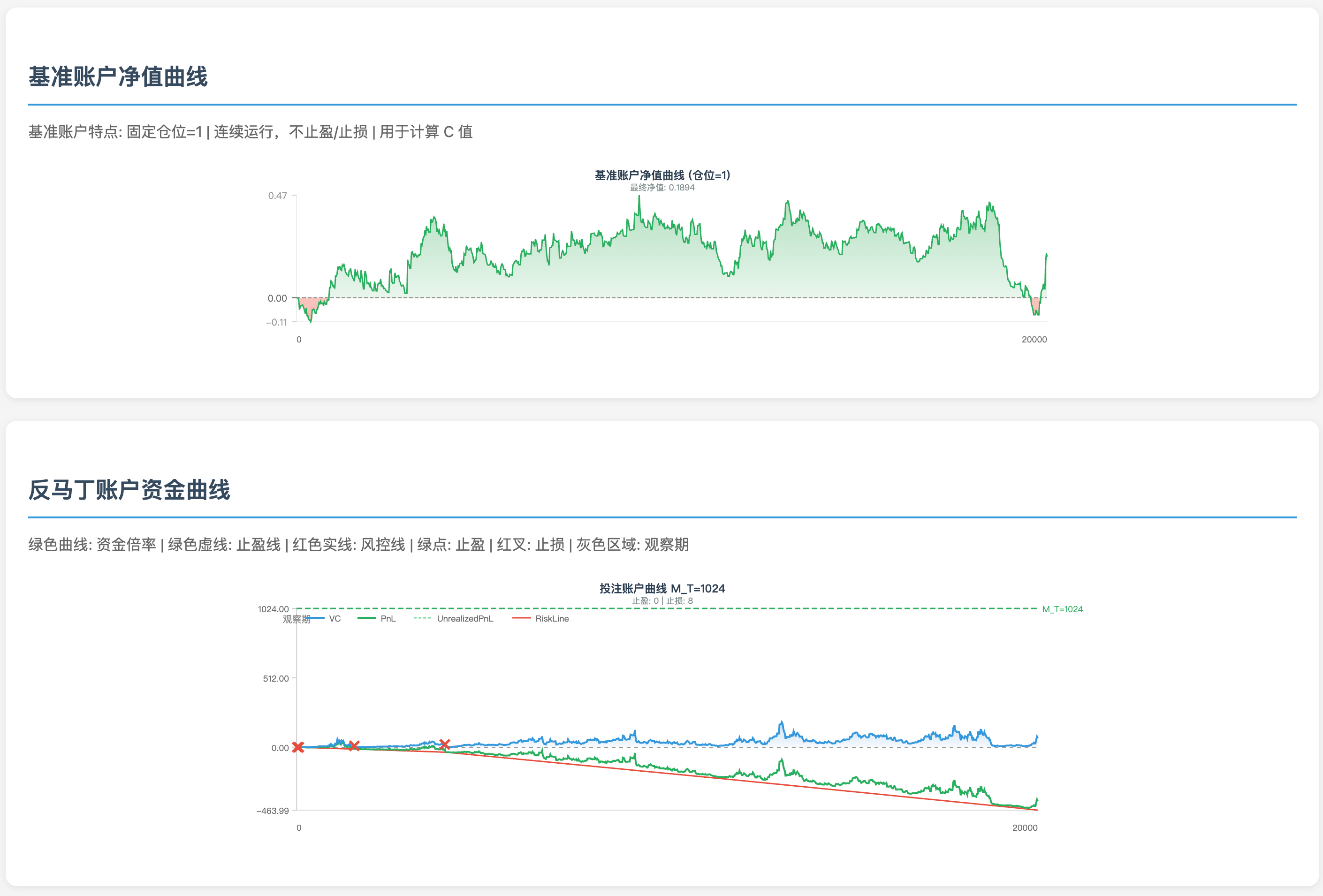
The baseline account remains exactly the same. However, the equity of the betting account declines continuously, with occasional rebounds, but it fails to meet the 1024x profit take-profit condition, ultimately leading to the equity dropping to zero.
This indicates that the quality of the signal strategy itself is also very important. If the signal strategy itself is of low quality, even using the anti-Martingale betting strategy will not yield good returns.
With the baseline strategy’s return at 18.94%, the betting strategy with 1024x TP ultimately achieves a return of -39475.30%, which is also a very significant difference.
However, we still obtain a good baseline signal strategy: a signal strategy with discernment and differentiation. We developed the basic dual moving average strategy to validate the system and to serve as a comparison for future signal strategies.
The two graphs above are very similar to the ones I described in The Protracted War of Capital.
Moreover, in The Three-Body Dynamics Hypothesis of Capital Markets, I also mentioned that shifts in market styles can cause the performance of trend-following strategies (momentum capital) to become unstable, exhibiting cyclical periods of significant gains and losses. In the future, we can design a gating mechanism based on the phase change theory proposed in the three-body dynamics hypothesis, betting on momentum strategies during momentum-favorable periods and withdrawing from momentum strategies before momentum-unfavorable periods. This will help verify the correctness of the three-body dynamics hypothesis.
