It is now the evening of January 27, 2026.
Focus on Content, Reduce Distractions in Writing
After reading C1's blog, I noticed he uses embedded TOCs to generate a table of contents.
I believe this imposes an unnecessary burden on the Markdown source files.
As shown in the image below, he writes nearly 40 lines of structure and metadata before getting to the actual content.
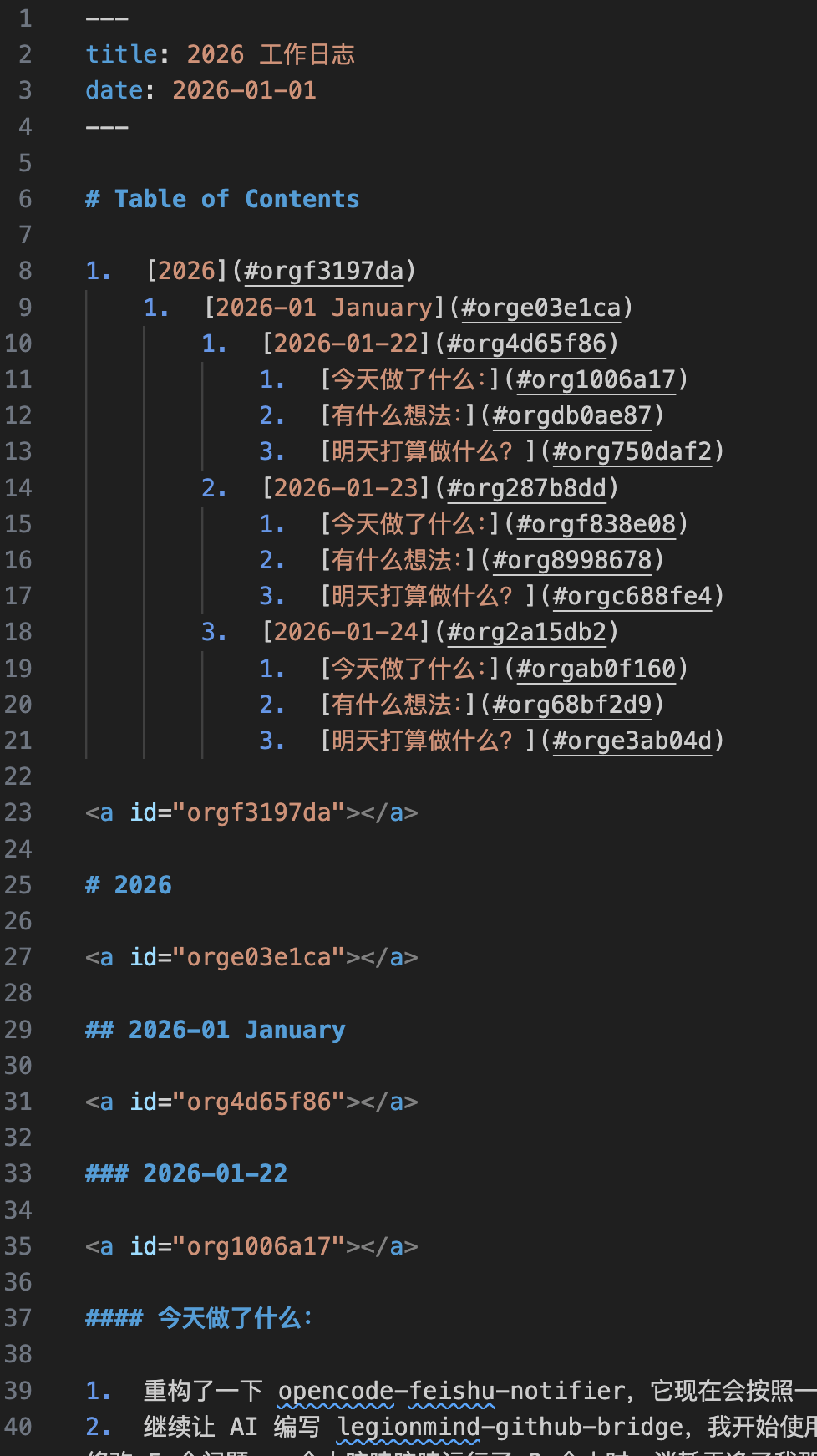
The issue is that the TOC source code is written directly into the source file. Although maintenance is likely handled by specialized tools, this fills the source file with a lot of "syntax tax" unrelated to the content. In fact, writing metadata in YAML FrontMatter is also a form of syntax tax. I strongly oppose this as well. However, YAML FrontMatter is not as visually cluttered as TOCs, so I haven't opposed it as vehemently before.
I firmly believe that once you start paying special attention to style, formatting, structure, and layout while writing, your focus shifts away from the content itself. Attention becomes scattered, affecting writing efficiency, quality, and ultimately, content creation.
When writing, a person's eyes are constantly reviewing previously written content. If the content is filled with various formatting syntax, attention is diverted, making it difficult to focus on the content itself.
In CZON, content metadata should be extracted, not embedded within the content itself. Content creators should not be forced to write this metadata. Content creation can be fragmented, with AI + Infra handling integration and layout. Reducing the "syntax tax" of writing is one of CZON's key metrics.
Mobile-First, but Desktop Can Offer More Optimizations.
Mobile devices are limited to a single-column scrolling layout, while desktop can utilize multi-column layouts. Therefore, the reading experience on desktop can be significantly better. For example, navigation bars, table of contents sidebars, etc., can be placed in sidebars, making full use of the desktop's wider screen. For desktop, footnotes could even be converted into sidenotes, similar to some large-format printed books.
For long articles, anchors are also an essential feature. Since CZON 0.6.3, automatic TOC extraction and heading anchor functionality have been supported.
More Interesting Features
For example, support for inline comments. This would allow readers/AI to add comments and discussions at any point in the article. This could greatly enhance content interactivity and engagement. Apps like WeChat Reading and WeChat Official Accounts support this kind of underline/comment interaction. The downside is that if the original text changes, comment positions might become misaligned, requiring a more stable positioning method.
